What Other Countries Have Monarchs That Are Related to Spain Royal Family

A map of Europe showing monarchies (red) and republics (blue).
Monarchy was the prevalent course of government in the history of Europe throughout the Center Ages, simply occasionally competing with communalism, notably in the example of the Maritime republics and the Swiss Confederacy.
Republicanism became more than prevalent in the Early on Modern period, but monarchy remained predominant in Europe during the 19th century. Since the finish of World State of war I, still, well-nigh European monarchies have been abolished. There remain, as of 2022, twelve sovereign monarchies in Europe. 7 are kingdoms: Denmark, Norway, Sweden, the United Kingdom, Espana, the Netherlands, and Belgium. Andorra, Principality of liechtenstein, and Monaco are principalities, while Grand duchy of luxembourg is a Grand Duchy. Vatican City is a theocratic constituent monarchy ruled past the Pope.
The monarchies can exist divided into ii broad classes: premodern states and those that gained their independence during or immediately after the Napoleonic Wars. Denmark, Norway, Sweden, the UK, Spain, and Andorra are the successors to premodern monarchies. Liechtenstein, kingdom of the netherlands, Kingdom of belgium, and Luxembourg were established or gained independence through various methods during the Napoleonic Wars. The State of the The holy see was recognized as a sovereign state administered by the Holy See in 1929.
Ten of these monarchies are hereditary, and ii are elective: The holy see (the Pope, elected at the papal conclave), and Principality of andorra (technically a semi-constituent diarchy, the joint heads of state being the elected President of France and the Bishop of Urgell, appointed by the Pope).
Well-nigh of the monarchies in Europe are constitutional monarchies, which means that the monarch does non influence the politics of the land: either the monarch is legally prohibited from doing so, or the monarch does not utilize the political powers vested in the office by convention. The exceptions are Liechtenstein and Monaco, which are commonly considered semi-constitutional monarchies due to the big influence the princes nevertheless accept on politics, and State of the vatican city, which is an absolute monarchy. There is currently no major campaign to abolish the monarchy (encounter monarchism and republicanism) in whatsoever of the twelve states, although in that location is a modest minority of republicans in many of them (east.thousand. the political organisation Republic in the Britain). Currently six of the twelve monarchies are members of the European Matrimony: Belgium, Denmark, Luxembourg, the netherlands, Spain and Sweden.
At the start of the 20th century, France, Switzerland and San Marino were the merely European nations to accept a republican form of government. The rising of republicanism to the political mainstream started just at the beginning of the 20th century, facilitated by the toppling of diverse European monarchies through war or coups d'etat; equally at the beginning of the 21st century, most of the states in Europe are republics with either a directly or indirectly elected head of land.
History [edit]
Origins [edit]
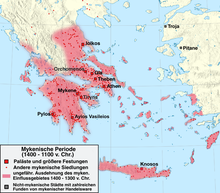
The notion of kingship in Europe ultimately originates in systems of tribal kingship in prehistoric Europe. The Minoan (c. 3200 – c. 1400 BCE) and Mycenaean civilization (c. 1600 – c. 1100 BCE) provide the primeval examples of monarchies in protohistoric Greece. Thanks to the decipherment of the Linear B script in 1952, much knowledge has been caused about lodge in the Mycenaean realms, where the kings functioned as leaders of palace economies.[1] The role of kings changed in the following Greek Nighttime Ages (c. 1100 – c. 750 BCE) to large gentleman farmers with military power.[1]
Primitive and classical artifact [edit]

Since the first of antiquity, monarchy confronted several republican forms of authorities, wherein executive ability was in the easily of a number of people that elected leaders in a certain way instead of appointing them by hereditary succession. During the primitive period (c. 750–500 BCE), kingship disappeared in almost all Greek poleis,[two] and besides in Rome (and then still a barely pregnant boondocks). Afterward the demise of kingship, the Greek city-states were initially most oftentimes led by nobility (elite), afterwards which their economic and military power base of operations crumbled. Side by side, in almost all poleis tyrants usurped power for two generations (tyranny, 7th and especially 6th century BCE), after which gradually forms of governments led by the wealthy (oligarchy) or assemblies of free male citizens (commonwealth) emerged in Classical Hellenic republic (mainly after 500 BCE).[iii] Athenian democracy (6th century–322 BCE) is the best-known case of the latter grade; classical Sparta (c. 550–371 BCE) was a militaristic polis with a remarkable mix between monarchy (dual kingship), elite (Gerousia) and democracy (Apella);[4] the Roman Commonwealth (c. 509–27 BCE) had a mixed constitution of oligarchy, democracy and peculiarly aristocracy.[5] The urban center-states of the Etruscan culture (which arose during the Villanovan menstruum, c. 900–700 BCE) appear to accept followed a like pattern, with the original monarchies being overthrown and replaced by oligarchic republics in the fifth and 4th centuries BCE.[6] : viii:18

The dominant poleis of Athens and Sparta were weakened by warring each other, especially during the Peloponnesian State of war (431–404 BCE) won by Sparta. They were defeated and ruled past Thebes for a time (371–360 BCE), later which Sparta's role was over. Eventually, all of Greece was subjugated by the Macedonian monarchy in 338 BCE, that put an end to the era of free democratic city-states, and Athenian democracy every bit well in 322 BCE.[7] In the subsequent Hellenistic period (334–30 BCE)[eight] numerous diadochs (successors of Alexander the Great) fought one another for the kingship of Macedon, definitively obtained past the Antigonids in 277 BCE.[9] Meanwhile, the Phoenician city-country of Carthage, located in present-day Tunisia, aside from settling large swaths of Due north Africa's coast, as well fix upward several colonies on Sicily, Sardinia, Corsica, the Baleares and in southern Iberia.[10] The Carthaginian empire, according to tradition founded in 814 BCE, started out as a monarchy, only in the 4th century transformed into a republic where suffets ("judges") ruled. Finally, Rome gradually conquered all of Italia (primarily subsequently 350 BCE), and defeated Carthage in the Punic Wars (264–146 BCE). In 168, Macedon was subdued past the Romans, and partitioned into 4 customer republics. These were annexed equally Roman provinces in 148, as happened to Hellenic republic in 146,[9] making Rome's territory envelop all of literate Europe. The remainder of Iberia, the Illyrian coast and somewhen Gaul by full general Julius Caesar were added to the Roman Republic, which however was experiencing an institutional crisis. After defeating his rival Pompey, Caesar was appointed dictator to restore social club. He nearly managed to found a dynasty in the process, but was killed by a republican cabal led by Brutus in 44 BCE.
Roman Empire and legacy [edit]
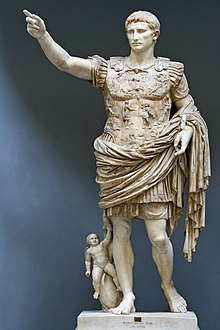
The offset Roman Emperor, Augustus (r. 27 BCE–fourteen CE).
Caesar's adoptive son Octavian prevailed in the ensuing civil war, and converted the Roman Republic into the Roman Empire in 27 BCE. He took on the name Augustus, with the rather humble title of princeps ("first [citizen]"), as if he were merely primus inter pares ("outset among equals"), when he had in fact founded a monarchy. This limited emperorship (Principate) was strengthened in 284 by Diocletian to absolute reign (Dominate).[11] The Empire recognised various client kingdoms under imperial suzerainty; most of these were in Asia, simply tribal client kings were besides recognized by the Roman authorities in Britannia. Most of the barbarian kingdoms established in the 5th century (the kingdoms of the Suebi, Burgundi, Vandals, Franks, Visigoths, Ostrogoths) recognised the Roman Emperor at least nominally, and Germanic kingdoms would continue to mint coins depicting the Roman emperor well into the 6th century.[12] It was this derivation of the authority of kingship from the Christian Roman Empire that would exist at the cadre of the medieval establishment of kingship in Europe and its notion of the divine right of kings, besides as the position of the Pope in Latin Christendom, the restoration of the Roman Empire under Charlemagne and the derived concept of the Holy Roman Empire in Western and Central Europe.
Medieval Europe [edit]
The monarchies of Europe in the Christian Heart Ages derived their claim from Christianisation and the divine right of kings, partly influenced by the notion of sacral kingship inherited from Germanic antiquity. The great powers of Europe in the Early on Modern flow were the issue of a gradual process of centralization of power taking place over the course of the Middle Ages.
The Early Middle Ages begin with a fragmentation of the former Western Roman Empire into "barbaric kingdoms". In Western Europe, the kingdom of the Franks adult into the Carolingian Empire past the 8th century, and the kingdoms of Anglo-Saxon England were unified into the kingdom of England by the 10th century. With the breakup of the Carolingian Empire in the ninth century, the arrangement of feudalism places kings at the head of a pyramid of relationships betwixt liege lords and vassals, dependent on the regional rule of barons, and the intermediate positions of counts (or earls) and dukes. The core of European feudal manorialism in the Loftier Middle Ages were the territories of the kingdom of France, the Holy Roman Empire (centered on the nominal kingdoms of Federal republic of germany and Italian republic) and the kingdoms of England and Scotland.
Early on Modernistic Europe [edit]

European dominions of the Business firm of Habsburg in 1700
With the rise of nation-states and the Protestant Reformation, the theory of divine correct justified the king's absolute authority in both political and spiritual matters. The theory came to the fore in England under the reign of James I of England (1603–1625, too known as James VI of Scotland 1567–1625). Louis Xiv of France (1643–1715) strongly promoted the theory besides. Early modern Europe was dominated by the Wars of Religion, notably the Thirty Years' War, during which the major European monarchies developed into centralised bully powers sustained by their colonial empires. The main European powers in the early modernistic period were:
- the Kingdom of French republic with its colonial empire
- the Portuguese Empire of the Kingdom of Portugal (personal spousal relationship with Spain 1580–1640)
- the Spanish Empire of Habsburg Spain (after 1700 Bourbon Spain)
- the British Empire of the English and Scottish Union of the Crowns (subsequently 1707 the Kingdom of Great U.k.)
- the Holy Roman Empire was effectively dominated by the Habsburg Monarchy and an emerging by Prussia
- the Tsardom of Russia
- the kingdom of Poland as the Shine–Lithuanian Democracy
- the kingdom of Sweden rose to the condition of great ability every bit the insufficiently short-lived Swedish Empire due to the Thirty Years' State of war
- the kingdom of Denmark-Norway
The House of Habsburg became the near influential royal dynasty in continental Europe past the 17th century, divided into the Spanish and Austrian branches.
Modernistic Europe [edit]
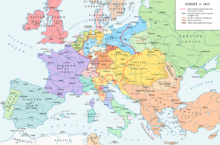

The mod resurgence of parliamentarism and anti-monarchism began with the temporary overthrow of the English monarchy by the Parliament of England in 1649, followed past the American Revolution (1775–83) and especially the French Revolution (1789–99). The absolutist Kingdom of France was first transformed to a ramble monarchy (1791–92), before existence fully abolished on 21 September 1792, and eventually the former king fifty-fifty executed, to the other European courts' great shock. During the subsequent French Revolutionary Wars (1792–1799), the great European monarchies were unable to restore the monarchy; instead, the French Beginning Republic expanded and annexed neighbouring territories, or converted them into loyal sister republics. Meanwhile, the High german Mediatization of 1803 thoroughly rearranged the political structure of the Holy Roman Empire, with many small principalities and all ecclesiastical lands beingness annexed by larger monarchies. Later on Napoleon seized power, however, he gradually constructed a new imperial order in French-controlled Europe, first by crowning himself Emperor of the French in 1804, and so converting the sis republics into monarchies ruled past his relatives. In July 1806 due to Napoleon's campaigns a larger number of states in the Western part of Deutschland seceded The Holy Roman Empire and this brought in August 1806 the emperor Francis Ii to make up one's mind dissolving the unabridged empire, bringing an end to 1833 years of history of Roman emperors in Europe.
Following Napoleon's defeat in 1814 and 1815, the reactionary Congress of Vienna determined that all of Europe should consist of potent monarchies (with the exception of Switzerland and a few insignificant republics). In France, the Bourbon dynasty was restored, replaced by the liberal July Monarchy in 1830, before the entire monarchy was again abolished during the Revolutions of 1848. The pop Napoleon III was able to proclaim himself Emperor in 1852, thus founding the Second French Empire.
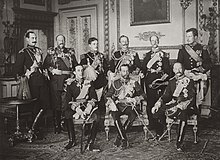
Ix Sovereigns at Windsor for the funeral of King Edward VII in 1910
The kingdoms of Sicily and Naples ("Two Sicilies") were absorbed into the kingdom of Sardinia to form the Kingdom of Italian republic in 1861. Austria and Prussia vied to unite all German states nether their banner, with Prussia emerging victorious in 1866. It succeeded in provoking Napoleon 3 to declare war, leading to the defeat of France, and the assimilation of the southern German states into the German Empire in the procedure (1870–71). From the ashes of the Second Empire rose the French Third Republic, the only groovy republican European power until World War I.
Much of 19th century politics was characterised by the segmentation between anti-monarchist radicalism and monarchist conservatism. The Spain was briefly abolished in 1873, restored 1874–1931 and again in 1975 (or in 1947). The Kingdom of Portugal was abolished in 1910. The Russian Empire ended in 1917, the Kingdom of Prussia in 1918. The Kingdom of Hungary barbarous nether Habsburg rule in 1867 and was dissolved in 1918 (restored 1920–1946). As well, the Kingdom of Bohemia under Habsburg rule was dissolved in 1918.
The Napoleonic Wars transformed the political landscape of Europe, and a number of modern kingdoms were formed in a resurgence of monarchism later on the dissolution of the Holy Roman Empire and the defeat of the French Empire:
Many countries abolished the monarchy in the 20th century and became republics, specially in the wake of either World War I or World War 2.
New monarchies [edit]

A few new monarchies emerged for a cursory period of time in the final years of World War I:
Monarchies established or re-established during the interbellum period were:
Monarchies established or re-established from 1940 and onwards:
Territorial evolution [edit]
 |  | 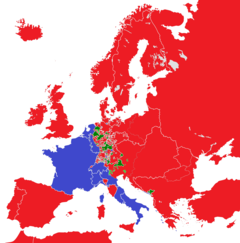 |  |
| 1714: after Kingdom of spain's Succession | 1789: French Revolution's eve | 1799: near the Revolution's end | European states in 1815 |
 | 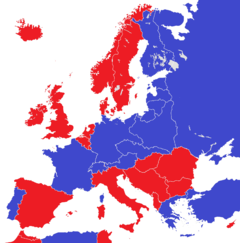 |  | 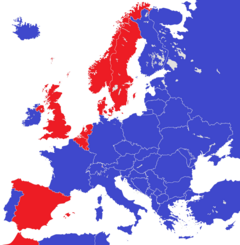 |
| European states in 1914 | European states in 1930 | European states in 1950 | European states in 2015 |
Monarchies
Republics
Ecclesiastical lands
Current monarchies [edit]
Table of monarchies in Europe [edit]
| State | Type | Succession | Dynasty | Championship | Image | Incumbent | Built-in | Age | Reigning since | Kickoff in line |
|---|---|---|---|---|---|---|---|---|---|---|
 Principality of Andorra Principality of Andorra | Constitutional | Ex officio | Bishop of Urgel | Co-prince | 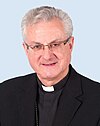 | Joan Enric Vives Sicília | 24 July 1949 | 72 | 12 May 2003 | None; appointed by the Pope |
| President of French republic |  | Emmanuel Macron[I] | 21 December 1977 | 44 | 14 May 2017 | None; successor elected in the next French presidential election. | ||||
 Kingdom of Belgium Kingdom of Belgium | Constitutional | Hereditary | Saxe-Coburg and Gotha | King |  | Philippe | 15 April 1960 | 61 | 21 July 2013 | Heir apparent: Princess Elisabeth, Duchess of Brabant (eldest kid) |
 Kingdom of Kingdom of denmark Kingdom of Kingdom of denmark | Constitutional | Hereditary | Glücksburg | Queen | 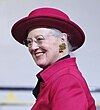 | Margrethe II | xvi April 1940 | 81 | 14 January 1972 | Heir apparent: Crown Prince Frederik (eldest child) |
 Principality of Liechtenstein Principality of Liechtenstein | Constitutional | Hereditary | Liechtenstein | Sovereign Prince |  | Hans-Adam II | xiv February 1945 | 77 | 13 November 1989 | Heir credible: Hereditary Prince Alois (eldest son) |
 Grand duchy of luxembourg Grand duchy of luxembourg | Ramble | Hereditary | Nassau-Weilburg (Bourbon) | Grand Duke | 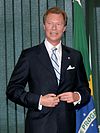 | Henri | sixteen April 1955 | 66 | seven October 2000 | Heir apparent: Hereditary Grand Duke Guillaume (eldest kid) |
 Principality of Monaco Principality of Monaco | Constitutional | Hereditary | Grimaldi | Sovereign Prince |  | Albert II | 14 March 1958 | 63 | 6 April 2005 | Heir credible: Hereditary Prince Jacques (only legitimate son) |
 Kingdom of kingdom of the netherlands Kingdom of kingdom of the netherlands | Constitutional | Hereditary | Orange-Nassau (Amsberg) | King | 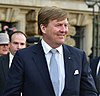 | Willem-Alexander | 27 Apr 1967 | 54 | xxx April 2013 | Heir credible: Princess Catharina-Amalia, Princess of Orangish (eldest kid) |
 Norway Norway | Constitutional | Hereditary | Glücksburg | Rex |  | Harald V | 21 February 1937 | 85 | 17 January 1991 | Heir apparent: Crown Prince Haakon (merely son) |
 Kingdom of spain Kingdom of spain | Constitutional | Hereditary | Bourbon | King |  | Felipe VI | 30 January 1968 | 54 | xix June 2014 | Heir presumptive: Leonor, Princess of Asturias (elder girl)[Two] |
 Kingdom of Sweden Kingdom of Sweden | Constitutional | Hereditary | Bernadotte | Male monarch |  | Carl XVI Gustaf | xxx April 1946 | 75 | 15 September 1973 | Heir apparent: Crown Princess Victoria (eldest child) |
 U.k. of Uk and Northern Republic of ireland U.k. of Uk and Northern Republic of ireland | Constitutional | Hereditary | Windsor | Queen | 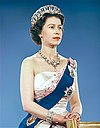 | Elizabeth II[Three] | 21 April 1926 | 95 | 6 February 1952 | Heir apparent: Charles, Prince of Wales (eldest kid) |
 Vatican City State Vatican City State | Absolute | Elective | – | Pope | 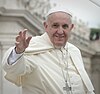 | Francis | 17 December 1936 | 85 | xiii March 2013 | Elective |
I ^ The co-prince of Andorra is also the president of  France. France. 2 ^ Leonor is, as the reigning male monarch's older girl, the current heiress presumptive. Felipe Half-dozen has no sons. 3 ^ The monarch of the United Kingdom is also the sovereign of the fourteen other Democracy realms. | ||||||||||
Descriptions [edit]
Andorra [edit]
Andorra has been a co-principality since the signing of a paréage in 1278, when the count of Foix and the bishop of La Seu d'Urgell agreed to share sovereignty over the landlocked country. The principality was briefly annexed in 1396 and again in 1512–1513 by the Crown of Aragon. The kickoff female prince to rule Andorra was Isabella, Countess of Foix (1398–1413). After the title of the count of Foix had been passed to the kings of Navarre, and after Henry of Navarre had get Henry 4 of France, an edict was issued in 1607 which established the French caput of state equally the legal successor to the count of Foix in regard to the paréage. Principality of andorra was briefly annexed for a tertiary time by the First French Empire together with Catalonia in 1812–1813. After the Empire's demise, Andorra became independent again.[xiii] The current joint monarchs are Bishop Joan Enric Vives Sicília and President Emmanuel Macron of France.
Kingdom of belgium [edit]
Belgium has been a kingdom since 21 July 1831 without suspension, after it became independent from the Britain of the Netherlands with Léopold I as its first king. While in a referendum held on 12 March 1950, 57.68 pct of the Belgians voted in favor of allowing Leopold III, whose conduct during World War 2 had been considered questionable and who had been accused of treason, to return to the throne; due to civil unrest, he opted to abdicate in favor of his son Baudouin on 16 July 1951.[14] The current monarch is Philippe.
Denmark [edit]
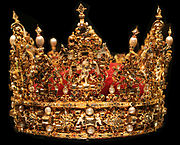
In Kingdom of denmark, the monarchy goes back to the legendary kings before the 10th century and the Danish monarchy is the oldest in Europe (with the first attested historical king being Ongendus effectually the year 710). Currently, nigh 80 percent support keeping the monarchy.[15] The current monarch is Margrethe II. The Danish monarchy likewise includes the Faroe Islands and Greenland which are parts of the Kingdom of denmark with internal home dominion. Due to this status, the monarch has no separate title for these regions. On her accession to the throne in 1972 Margrethe II, the nowadays monarch, refrained from using the additional titles historically associated with the Danish monarchs for more than 750 years and just styled herself Queen of Denmark.
Liechtenstein [edit]
Liechtenstein formally came into existence on 23 January 1719, when Charles VI, Holy Roman Emperor decreed the lordship of Schellenberg and the countship of Vaduz united and raised to the dignity of a principality. Liechtenstein was a part of the Holy Roman Empire until the Treaty of Pressburg was signed on 26 Dec 1805; this marked Liechtenstein's formal independence, though it was a member of the Confederation of the Rhine and the German Confederation afterwards. While Liechtenstein was however closely aligned with Austria-hungary until World War I, it realigned its politics and its customs and monetary institutions with Switzerland instead.[16] Having been a constitutional monarchy since 1921, Hans-Adam Ii demanded more influence in Liechtenstein's politics in the early on 21st century, which he was granted in a referendum held on 16 March 2003, finer making Liechtenstein a semi-constitutional monarchy once again. However, technically speaking, Principality of liechtenstein's monarchy remains fully ramble, and the transition was merely from a parliamentary system to a semi-presidential system, and the constitutional changes likewise provide for the possibility of a referendum to abolish the monarchy entirely.[17] The current monarch is Hans-Adam 2, who turned over the day-to-solar day governing decisions to his son and heir Alois, Hereditary Prince of Liechtenstein on 15 Baronial 2004.
Luxembourg [edit]
Luxembourg has been an independent thou duchy since ix June 1815. Originally, Grand duchy of luxembourg was in personal union with the United Holland and the Kingdom of the Netherlands from xvi March 1815 until 23 November 1890. While Wilhelmina succeeded Willem III in holland, this was not possible in Grand duchy of luxembourg due to the order of succession being based on Salic law at that fourth dimension; he was succeeded instead by Adolphe. In a referendum held on 28 September 1919, 80.34 per cent voted in favor of keeping the monarchy.[eighteen] The electric current monarch is Henri.
Monaco [edit]
Monaco has been ruled by the House of Grimaldi since 1297. From 1793 until 1814, Monaco was under French command; the Congress of Vienna designated Monaco every bit beingness a protectorate of the Kingdom of Sardinia from 1815 until 1860, when the Treaty of Turin ceded the surrounding counties of Nice and Savoy to France. Menton and Roquebrune-Cap-Martin, part of Monaco until the mid-19th century before seceding in hopes of being annexed by Sardinia, were ceded to France in substitution for four,000,000 French francs with the Franco-Monegasque Treaty in 1861, which also formally guaranteed Monaco its independence.[nineteen] Until 2002, Monaco would have get function of France had the house of Grimaldi ever died out; in a treaty signed that year, the two nations agreed that Monaco would remain independent even in such a case. The current monarch is Albert II.
Netherlands [edit]
Though while non using the title of king until 1815, the Dutch Regal House has been an intricate part of the politics of the Depression Countries since medieval times. In 1566, the stadtholder William of Orange became the main leader of the Dutch revolt against the Spanish Habsburgs that gear up off the Lxxx Years' War and resulted in the formal independence of the United Provinces in 1581. He was built-in in the House of Nassau as Count of Nassau-Dillenburg. He became Prince of Orangish in 1544 and is thereby the founder of the branch House of Orange-Nassau
His descendants became de facto heads of state of the Dutch Republic during the 16th to 18th centuries, which was an effectively hereditary role. For the last half century of its existence, it became an officially hereditary role and thus a monarchy (though maintaining republican pretense) nether Prince William 4. His son, Prince William V, was the last stadtholder of the democracy, whose own son, Rex William I, became the get-go rex of the United Kingdom of the netherlands, which was established on sixteen March 1815 later the Napoleonic Wars. With the independence of Belgium on 21 July 1831, the Netherlands formally became the Kingdom of the netherlands. The electric current monarch is Willem-Alexander.
Norway [edit]
Norway was united and thus established for the first time in 872, as a kingdom. As a result of the unification of the Norwegian footling kingdoms, which traces the monarchs even further back in fourth dimension, both legitimate and semi–legendary kings. It is thus one of the oldest monarchies in the earth, along with the Swedish and Danish ones. Kingdom of norway was part of the Kalmar Marriage from 1397 until 1524, then part of Denmark–Norway from 1536 until 1814, and finally an autonomous part of the Union between Sweden and Norway from 1814 until 1905. Norway became completely contained again on 7 June 1905. Support for establishing a democracy lies around xx per cent.[20] The electric current monarch is Harald V.
Spain [edit]
Kingdom of spain came into existence equally a single, united kingdom of great britain and northern ireland under Charles I of Espana on 23 January 1516. The monarchy was briefly abolished by the Kickoff Spanish Commonwealth from xi February 1873 until 29 December 1874. The monarchy was abolished again on 14 April 1931, first by the Second Spanish Republic – which lasted until 1 April 1939 – and subsequently by the dictatorship of Francisco Franco, who ruled until his expiry on 20 Nov 1975. Monarchy was restored on 22 November 1975 under Juan Carlos I, who was too the monarch until his abdication in 2014. His son Felipe Six is the current monarch. The 1978 constitution confirms the championship of the monarch is the King of Spain, only that he may besides utilize other titles historically associated with the Crown,[21] including the kingdoms of Castile and León, Aragon, the Ii Sicilies, Jerusalem, Navarre, Granada, Seville, Toledo, Valencia, Galicia, Sardinia, Córdoba, Corsica, etc.
Data from 2006 suggested that but 25 percent of Spaniards were in favor of establishing a democracy;[22] however, the numbers have increased since Juan Carlos I abdicated.[23]
Sweden [edit]
Sweden's monarchy goes dorsum well-nigh as far equally the Danish 1, to the semilegendary kings before the 10th century, since and then information technology has not been interrupted. However, the unification of the rivalling kingdoms Svealand and Götaland (consolidation of Sweden) did not occur until some fourth dimension later, perchance in the early on 11th century. The electric current royal family, the Business firm of Bernadotte, has reigned since 1818. The current monarch is Carl Xvi Gustaf.
United kingdom of great britain and northern ireland [edit]
The monarchy of the United Kingdom can be defined to accept started either with the Kingdoms of England (871) or Scotland (843), with the Union of the Crowns on 24 March 1603, or with the Acts of Wedlock of one May 1707. It was briefly interrupted by the English language Interregnum, with the Commonwealth of England existing in its stead from thirty January 1649 until 15 Dec 1653 and from 26 May 1659 until 25 May 1660 and the Protectorate taking its place from sixteen December 1653 until 25 May 1659. The electric current monarch is Elizabeth II.
Support for establishing a republic instead of a monarchy was around 18 per cent in the United Kingdom in 2006, while a majority thinks that there will withal be a monarchy in the United kingdom of great britain and northern ireland in x years' time, public stance is rather uncertain near a monarchy all the same existing in l years and a clear majority believes that the monarchy will no longer exist a century after the poll.[24] Public stance is, however, certain that the monarchy will withal be in thirty years. About 30 per cent are in favour of discontinuing the monarchy later on Elizabeth's death.
The monarch of the United kingdom is also the monarch of the fourteen other Republic realms, none of which are in Europe. Some of these realms accept pregnant levels of support for republicanism.[25]
Vatican City [edit]
Differently from vatican city, in existence for virtually two thousand years, the State of the vatican city was not a sovereign state until the 20th century. In the 19th century the looting of the Papal States by the Kingdom of Sardinia, and the subsequent institution of the Kingdom of Italy, was non recognized by the Vatican. However, past the Lateran treaty of 1929, the Kingdom of Italia recognized Vatican city equally an independent state, and vice versa.[26] Since then, the elected monarch of the The holy see state has been the current pope. The pope nevertheless officially carries the title "King of the Ecclesiastical State" (in Latin: Rex Condition Ecclesiæ).
Succession laws [edit]

European monarchies by succession.
The succession guild is adamant by primogeniture in virtually European monarchies. Belgium, Denmark, Luxembourg, the netherlands, Kingdom of norway, Sweden and the Uk[27] now adhere to absolute primogeniture, whereby the eldest child inherits the throne, regardless of gender; Monaco and Spain take the older system of male-preference primogeniture, while Liechtenstein uses agnatic primogeniture. In 1990, Kingdom of norway granted absolute primogeniture to the Norwegian throne, meaning that the eldest kid, regardless of gender, takes precedence in the line of succession. This was non, however, washed retroactively (as, for case, Sweden had done in 1980), pregnant that Haakon, Crown Prince of Kingdom of norway continues to take precedence over his older sister.
In that location are plans to change to accented primogeniture in Espana[28] through a rather complicated procedure, as the change entails a constitutional amendment. Two successive parliaments will take to pass the police force by a two-thirds majority and then put information technology to a plebiscite. As parliament has to be dissolved and new elections have to be called later the constitutional subpoena is passed for the first time, then Prime Minister of Spain José Luis Rodríguez Zapatero indicated he would await until the end of his showtime term in 2008 earlier passing the police force,[29] although this borderline passed without the referendum being called. The subpoena enjoys strong public support.[thirty]
To alter the society of succession to the British throne, all the sovereign states with the Queen as head of country—collectively known every bit Commonwealth realms—must agree. In the Uk, the Succession to the Crown Act 2013 was enacted, and later on legislation in another realms, the changes came into effect across all realms simultaneously on 26 March 2015.
Liechtenstein uses agnatic primogeniture (aka Salic constabulary), which completely excludes women from the gild of succession unless there are no male person heirs of whatever kind present, and was criticised for this by a United Nations committee for this perceived gender equality upshot in Nov 2007.[31]
Grand duchy of luxembourg as well used agnatic primogeniture until 20 June 2011, when absolute primogeniture was introduced.[32]
The co-princes of Andorra are the president of the French Democracy, who is elected by the French people, and the Bishop of La Seu d'Urgell, who is appointed past the Pope.
The absolute monarch of State of the vatican city, the Pope, is elected by the College of Cardinals. The current ruler is Pope Francis.
Costs [edit]
One issue that occasionally rises is whether the monarchies are as well expensive when compared to republics, or whether particular monarchies are more expensive than others, to maintain. This comparing may be hard to draw, since fiscal assistants may differ radically from country to country, and not all profits and costs are publicly known, and because of different arrangements regarding the private property of the monarch. In the U.k., the Crown Estate has a special legal status making it neither government property nor the private property of the monarch. Revenues from these hereditary possessions have been placed at the disposition of the British regime (thus proceeding straight to the Treasury) past every monarch since the accession of George 3 in 1760; the revenues of GBP 304.1 million (fiscal year of 2015/16) far exceed the expenses of the British royal family unit in this sense resulting in a "negative toll" of the British monarchy.
In 2016, Dutch paper de Volkskrant published an overview of the almanac expenditure (excluding security expenses) of all European imperial houses (not counting Luxembourg and the iv monarchical European microstates).
| State | Almanac costs (royal house} | Annual salary (monarch) | Does monarch pay taxes? | Annual costs (royal house, per taxpayer) |
|---|---|---|---|---|
| Belgium | €36 1000000 | €eleven.5 million | Yes | €3.15 |
| Denmark | €13 one thousand thousand | €ten 1000000 | Simply inheritance taxation | €ii.30 |
| Netherlands | €41 one thousand thousand | €0.9 1000000 | No | €2.40 |
| Norway | €51 1000000 | €1.2 million | No | €9.70 |
| Kingdom of spain | €8 meg | €0.2 million | Yeah | €0.16 |
| Sweden | €13 million | €six.vii million | Yes | €1.30 |
| United Kingdom | €45 one thousand thousand | €15.six meg | Yeah | €0.seventy |
Source: de Volkskrant (2016), based on the royal houses' websites of the 7 monarchies, professor Herman Matthijs' 2013 study,[33] the Dutch National Budget 2017, and ABCTOPConsult. [34]
In 2013, professor Herman Matthijs from Ghent University calculated the costs of the seven EU monarchies plus Norway, and compared them to the EU's ii almost populous republics, France and Germany. His four primary conclusions were:
- The personal salaries of presidents are lower than those of monarchs;[33]
- The transparency differs between republics and monarchies, and is formally regulated in republics;
- In republics, alimony costs of former heads of state are higher, although the figures don't say and so;
- The existence of subsidies to family members of the heads of state in some monarchies increases their expenses.
He stressed that the fiscal assistants'south transparency differs enormously between countries; especially the not-transparent monarchies may be much more expensive than is publicly known. This means comparing them to republics, specially the very transparent administration of France where citizens tin know exactly what they pay for, may be unfair. In a 2015 interview with NRC Handelsblad, Matthijs commented that the then-known €7.7 million allotted to the majestic house in Spain'south national budget was 'unbelievable': "I tin't find out more, simply I understand from the media that the total expenses of the Spanish house may be equally much as fourscore one thousand thousand."[35]
| Country | Form of government | Official annual costs | Transparency |
|---|---|---|---|
| Belgium | Monarchy | €xiii.9 1000000 | Not transparent |
| Denmark | Monarchy | €13.ii million | Not transparent |
| French republic | Commonwealth | €106.ii million | Very transparent |
 Federal republic of germany Federal republic of germany | Republic | €25.half dozen 1000000 | Relatively transparent |
| Luxembourg | Monarchy | €9.3 1000000 | Non transparent |
| Netherlands | Monarchy | €39.9 1000000 | Relatively transparent |
| Kingdom of norway | Monarchy | €42.7 million | Relatively transparent |
| Spain | Monarchy | €7.9 million | Not transparent |
| Sweden | Monarchy | €xv.1 million | Not transparent |
| Britain | Monarchy | €38.0 million | Poorly transparent |
| Source: Herman Matthijs, "De kosten van een staatshoofd in West-Europa" (2013).[33] | |||
Calls for abolition [edit]
Calls for the abolition of Europe's monarchies were widespread since the development of republicanism in the 17th to 18th centuries during the Enlightenment. During the French Revolution, the Ancien Régime in French republic was abolished, and in all territories the French First Democracy conquered during the following Coalition Wars, sister republics were proclaimed. Nevertheless, later on Napoleon crowned himself Emperor of the French in 1804, all of these (except Switzerland) were converted back to monarchies headed by his relatives. The post-Napoleonic European Restoration reaffirmed the monarchical balance of power on the continent.
In subsequent decades, republicanism would regain lost ground with the rise of liberalism, nationalism, and later socialism. The Revolutions of 1848 were largely inspired by republicanism. Well-nigh of Europe'south monarchies were abolished either during or post-obit World State of war I or World War II, and the remaining monarchies were transformed into constitutional monarchies.
Republican movements in Europe remain active upwards to present, though their political clout is limited in most European monarchies. The most prominent organisations candidature to eliminate one or more of Europe's remaining monarchies and/or to liquidate assets reserved for reigning families are affiliated with the Brotherhood of European Republican Movements, only there are smaller independent initiatives as well, such as Hetis2013 in the Netherlands.[36] [37] As well, some political parties (e.grand. Podemos in Espana) have stepped up and chosen for national referenda to abolish monarchies.[38] [39]
Calls for restoration [edit]
The political influence of monarchism in erstwhile European monarchies is very limited.
There are several monarchist parties in France, almost notably the Activeness Française (established 1899) and Alliance Royale (established 2001). Monarchist parties as well exist in the Czech Republic (1991), in Greece (2010), in Germany (1959), in Italy (1972), in Poland (1988) and in Russian federation (2012).
Otto von Habsburg renounced all pretense to the Habsburg titles in 1958, and monarchism in Austria has side by side to no political influence; a German monarchist organisation called Tradition und Leben has been in beingness since 1959. Monarchism in Bavaria has had more significant support, including Franz Josef Strauss, government minister-president of Bavaria from 1978–1988.
Alexander, Crown Prince of Yugoslavia is a proponent of re-creating a constitutional monarchy in Serbia and sees himself equally the rightful king. He believes that monarchy could give Serbia "stability, continuity and unity".[40]
A number of political parties and organizations support a constitutional parliamentary monarchy in Serbia. The Serbian Orthodox Church has openly supported the restoration of the monarchy.[41] [42] The assassinated former Serbian Prime Minister Zoran Đinđić was often seen in the company of the prince and his family, supporting their campaigns and projects, although his Democratic Political party never publicly embraced monarchy.
In 2011 an online open access poll by Serbian heart-market tabloid newspaper Blic showed that 64% of Serbians support restoring the monarchy.[43] Some other poll in May 2013 had 39% of Serbians supporting the monarchy, with 32% against information technology.[44] On 27 July 2015, newspaper Blic published a poll "Da li Srbija treba da bude monarhija?" ("Should Serbia be a monarchy?"); 49.8% respondents expressed back up in a reconstitution of monarchy, 44.6% were opposed and 5.5% were indifferent.[45]
According to a 2007 opinion poll conducted at the request of the Romanian royal family, only 14% of Romanians were in favour of the restoration of the monarchy.[46] Another 2008 poll establish that but sixteen% of Romanians are monarchists.[47] In December 2017, on the backdrop of the increased capital of trust in the Royal House of Romania, re-emerging with the death of Male monarch Michael, the executive chairman of the ruling Social Democratic Party Nicolae Bădălau said that 1 could organize a referendum on the transition to the monarchical ruling form, arguing that "it is not a bad thing, considering that the countries that have the monarchs are developed countries", being a project of the futurity.[48]
See also [edit]
- Listing of European Union member states by political arrangement
- List of electric current monarchies
- Listing of monarchies
- List of dynasties
- Monarchies in the Americas
- Monarchies in Oceania
- Monarchies in Africa
- Monarchies in Asia
References [edit]
- ^ a b De Blois & Van der Spek (2004), p. 71–72.
- ^ De Blois & Van der Spek (2004), p. 74.
- ^ De Blois & Van der Spek (2004), p. 86–87.
- ^ Encarta-encyclopedie Winkler Prins (1993–2002) s.five. "geronten".
- ^ Encarta-encyclopedie Winkler Prins (1993–2002) due south.5. "Romeinse Rijk. §2. Staatsinstellingen".
- ^ Leo Rock, Ilkin Gambar, Officially Devin, Nolan Karimov, András Szente-Dzsida (20 February 2020). "Etruscans: Italian Civilization Before Ancient Rome". Kings and Generals. YouTube. Archived from the original on 17 November 2021. Retrieved 24 Feb 2020.
{{cite web}}: CS1 maint: multiple names: authors list (link) - ^ De Blois & Van der Spek (2004), p. 103–106.
- ^ Encarta-encyclopedie Winkler Prins (1993–2002) s.v. "hellenisme".
- ^ a b De Blois & Van der Spek (2004), p. 127.
- ^ Encarta-encyclopedie Winkler Prins (1993–2002) s.5. "Carthago. §1. Geschiedenis".
- ^ Encarta-encyclopedie Winkler Prins (1993–2002) s.v. "Diocletianus, Gaius Aurelius Valerius."
- ^ Henri Pirenne, Mohammed and Charlemagne (1937), 46–48.
- ^ United States Section of State – Under Secretary of Country for Public Affairs and Public Affairs – Bureau of Public Affairs. "Background Note: Andorra". Retrieved 12 September 2009.
- ^ european navigator (20 June 2006). "Full list of the results of the referendum on the upshot of the monarchy (13 March 1950)". Historical events – 1945–1949 The pioneering phase . Retrieved 28 June 2006.
- ^ "Republicans plan to cut Mary'south reign". The Age. Australia. 12 May 2004. Retrieved 27 June 2006.
- ^ United States Section of State – Under Secretary of Land for Public Diplomacy and Public Affairs – Agency of Public Affairs. "Background Note: Liechtenstein". Retrieved 12 September 2009.
- ^ Foreign and Democracy Office. "Country Profile: Liechtenstein". Archived from the original on 25 May 2011. Retrieved 25 November 2009.
- ^ Fayot, Ben (Oct 2005). "Les quartres référendums du Grand-Duché de Luxembourg" (PDF) (in French). Luxembourg Socialist Workers' Party. Archived from the original (PDF) on 27 September 2007. Retrieved 3 Baronial 2007.
- ^ United States Department of State – Under Secretary of Country for Public Diplomacy and Public Affairs – Bureau of Public Diplomacy. "Background Note: Monaco". Retrieved 12 September 2009.
- ^ Berglund, Nina (5 November 2005). "Monarchy losing support". Aftenposten. Archived from the original on 29 May 2006. Retrieved 4 April 2007.
- ^ Título II. De la Corona, Wikisource. Constitution of Spain 1978, Title II, Article 56, Subsection 2 and amended by Regal Decree 1368/1987, dated 6 November
- ^ Angus Reid (14 October 2006). "Spaniards Content with Monarchy". Angus Reid Global Monitor: Polls & Research. Archived from the original on 28 June 2013. Retrieved 14 Apr 2013.
- ^ Douwe Keulen, Jan (five June 2014). "The call for a third Castilian republic". Al Jazeera. Retrieved 16 July 2014.
- ^ Ipsos MORI (22 April 2006). "Monarchy Trends". Retrieved 27 June 2006.
- ^ "Where the queen still rules". The Guardian. Britain. 7 Nov 1999. Retrieved xxx June 2006.
- ^ United States Department of State – Under Secretary of State for Public Diplomacy and Public Affairs – Bureau of Public Diplomacy. "Groundwork Note: Holy Run into". Retrieved 12 September 2009.
- ^ "Overturning centuries of majestic rules". BBC. 28 Oct 2011. Retrieved 29 March 2018.
- ^ Fordham, Alive (8 November 2005). "War of Spanish succession looms while infant sleeps". The Times. UK. Retrieved 29 June 2006.
- ^ Tarvainen, Sinikka (26 September 2006). "Royal pregnancy poses political dilemma for Spain". Monsters and Critics. Archived from the original on 14 December 2011. Retrieved 27 September 2006.
- ^ Angus Reid (21 October 2006). "Spaniards Support Monarchy Amendment". Angus Reid Global Monitor: Polls & Research. Archived from the original on 28 June 2013. Retrieved 14 April 2013.
- ^ Pancevski, Bojan (19 November 2007). "No princesses: it's men only on this throne". The Times. UK. Retrieved 23 November 2007.
- ^ "New Ducal succession rights for One thousand Duchy". Luxemburger Wort. 21 June 2011. Archived from the original on 19 December 2012. Retrieved 21 June 2011.
- ^ a b c Herman, Matthijs (2013). "De kosten van een staatshoofd in W-Europa" (PDF). Tijdschrift voor Openbare Financiën (in Dutch). 45 (iii): 143–154.
- ^ Robert Giebels (27 October 2016). "Welk vorstenhuis is het duurste van Europa?". de Volkskrant (in Dutch). Retrieved 28 October 2016.
- ^ Philip de Witt Wijnen (16 October 2015). "Nederland heeft in Europa het duurste vorstenhuis". NRC Handelsblad (in Dutch). Retrieved 29 October 2016.
- ^ Hetis2013 Archived 27 December 2014 at the Wayback Auto
- ^ "Equally Dutch fix for new king, republicans ask to abolish monarchy". The Christian Scientific discipline Monitor. 29 April 2013. Retrieved 29 March 2018.
- ^ Madrid, Agence France-Presse in (8 June 2014). "Majority in Spain want referendum on future of monarchy". The Guardian . Retrieved 29 March 2018.
- ^ "Anti-monarchy protests persist in Spain". Al Jazeera. Retrieved 29 March 2018.
- ^ McKinsey, Kitty (27 June 1997). "Kings Endeavor for Comeback". San Francisco Chronicle. Archived from the original on 13 November 2007.
- ^ Letter from Patriarch Pavle to HRH Crown Prince Alexander II, 29 Nov 2003
- ^ Luxmoore, Jonathan (8 December 2003). "Serbian Orthodox Leader Calls For Monarchy To Be Reintroduced". Ecumenical News International. Archived from the original on x Oct 2006.
- ^ Roberts, Michael (five September 2011). "64% of Serbians polled vote Monarchy over Republic". Balkans.com Business News. Archived from the original on 11 July 2011.
- ^ 39 percent of Serbians in favor of monarchy, poll shows Archived 2 May 2013 at the Wayback Auto. Retrieved 2013-05-12.
- ^ ANKETA Da li Srbija treba da bude monarhija?. Blic. (in Serbian). July 2015.
- ^ (in Romanian) "NLP: Monarchy saves Basescu-mania" ("PNL: Monarhia salvează Băsescu-mania"), Cotidianul, 31 Baronial 2008
- ^ (in Romanaian) "Monarchy: desired by but 16% of the population" ("Monarhia, dorită de doar 16% din populaţie"), Cotidianul, 21 September 2008
- ^ dcnews. "Plebiscite pentru MONARHIE. Propunere Bădălău".
- "CIA – The World Factbook". The Earth Factbook. Central Intelligence Agency. xi July 2006. Retrieved 19 July 2006.
- "World Leaders". World Leaders. Central Intelligence Agency. 18 July 2006. Retrieved 19 July 2006.
Further reading [edit]
- Louda, Jiří; Maclagan, Michael (1991). Lines of Succession: Heraldry of the Regal Families of Europe. Macmillan. ISBN978-0-02-897255-8.
External links [edit]
-
 Media related to Monarchies of Europe at Wikimedia Commons
Source: https://en.wikipedia.org/wiki/Monarchies_in_Europe
0 Response to "What Other Countries Have Monarchs That Are Related to Spain Royal Family"
Postar um comentário